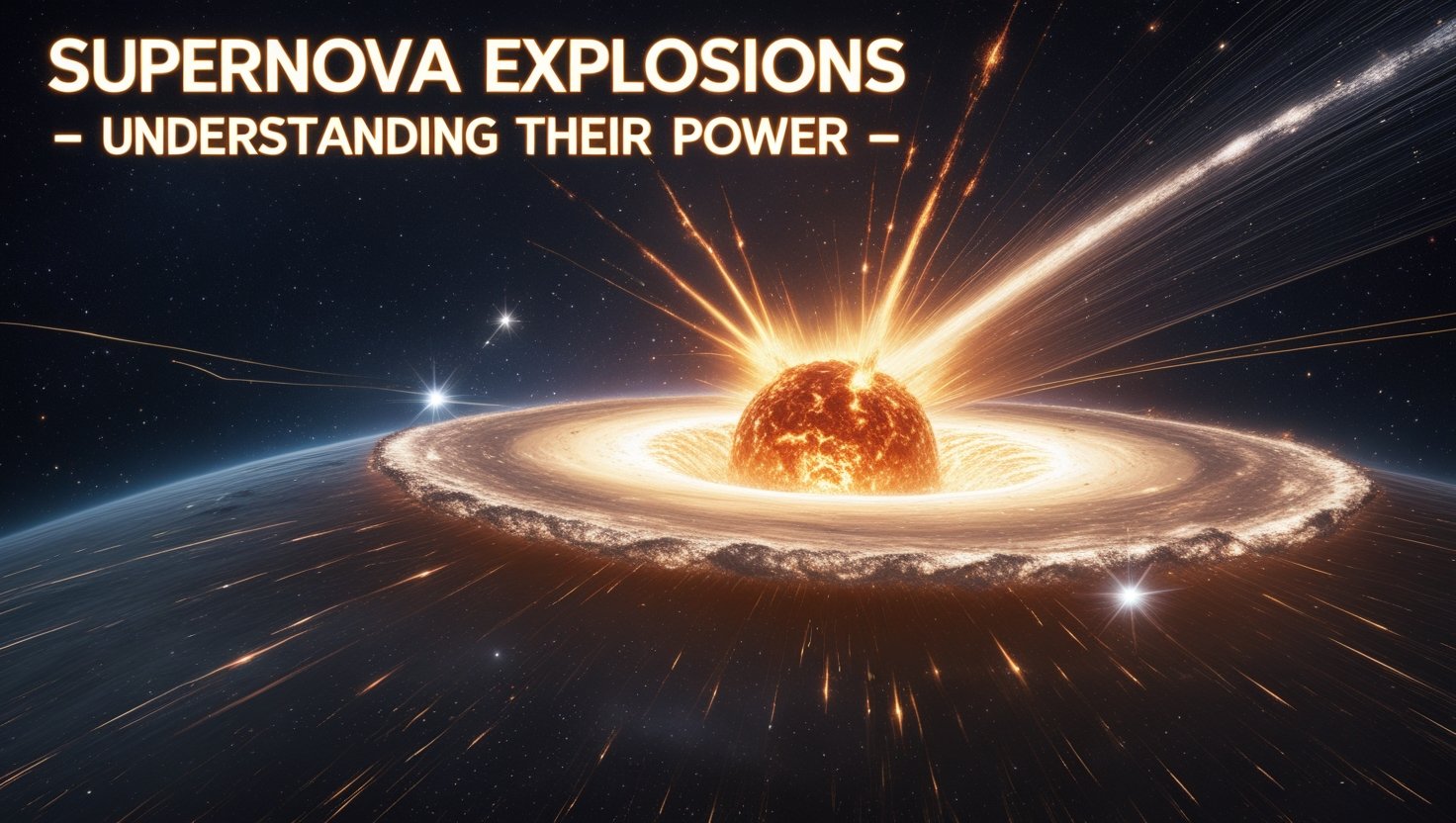
Imagine a cosmic burst so powerful it outshines an entire galaxy for a fleeting moment. Supernova Explosions offer a dramatic end to a star’s life and seed the universe with the raw ingredients for new beginnings.
The Stellar Journey:
Every star’s life is a story of balance between nuclear fusion and gravity. Stars are born from vast clouds of gas and dust, where gravity pulls matter together to ignite nuclear fusion. Over millions, or even billions, of years, these celestial furnaces convert hydrogen into helium, releasing energy that keeps them alight. However, not all stars end their lives quietly. As they exhaust their fuel, the delicate equilibrium between outward pressure and gravitational contraction falters.
For massive stars, this imbalance culminates in a catastrophic explosion that we recognize as a supernova. Within this grand cycle, death becomes a fiery rebirth that enriches the cosmos with heavy elements and paves the way for new star formation.
The Physics Behind the Explosion:
At the heart of every supernova explosion is a dramatic release of energy. In one scenario, known as a thermonuclear supernova (Type I), a white dwarf in a binary system accumulates matter from its companion. As the white dwarf’s mass approaches a critical threshold, conditions become ripe for runaway fusion, transforming carbon and oxygen into heavier elements in an instant. This uncontrollable chain reaction releases an immense amount of energy that tears the star apart.
Alternatively, in core‑collapse supernovae (Type II), a massive star exhausts its nuclear fuel and can no longer counteract its gravity. The core succumbs to gravitational collapse, leading to a rapid implosion that triggers an outward shock wave. This shock wave blasts the star’s outer layers into space, creating an explosion so luminous it can briefly rival the brightness of an entire galaxy. Both mechanisms are prime examples of astrophysical forces at work, where the laws of quantum mechanics and gravity interact to produce nature’s most brilliant fireworks.
Unraveling the Types:
Supernova explosions are generally classified into two major types based on their origin and spectral signatures:
- Type I Supernovae: These events occur in binary systems where a white dwarf accumulates material from a partner star or merges with another white dwarf. The ensuing runaway nuclear reactions obliterate the star entirely. Type I supernovae are further subdivided into Ia, Ib, and Ic, with Type Ia being especially useful as “standard candles” for measuring cosmic distances because of their consistent peak brightness.
- Type II Supernovae: In contrast, Type II events result from the core collapse of massive stars, typically those more than eight times the mass of the Sun. Once a star’s core is dominated by iron, a dead end for fusion, the collapse is inevitable. The spectacular rebound and outward blast expel vast layers of material, producing a luminous display and leaving behind compact remnants such as neutron stars or black holes.
Despite their differences, both types share common signatures of staggering energy release and rapid element synthesis, making them critical to our understanding of cosmic evolution.
Measuring the Might:
The sheer power of a supernova explosion is almost unfathomable. At its peak, a supernova can radiate more energy in a few seconds than our Sun will emit over its entire 10‑billion-year lifespan. The peak optical luminosity of these events can rival that of an entire galaxy, and the shock waves they generate propagate through space at velocities reaching several percent of the speed of light.
This explosive energy is measured in terms of kinetic energy and radiative output. The expelled material, weighing several solar masses, is accelerated into the surrounding interstellar medium, triggering further shocks and igniting the formation of new stars. Such tremendous energy not only lights up the cosmos but also drives the synthesis of heavy elements, from oxygen and silicon to iron and beyond. These elements are essential ingredients in the formation of planets and even life itself. In essence, a supernova explosion is a cosmic forge that recycles stellar material, ensuring that the universe remains a dynamic, ever-evolving landscape.
Supernova Remnants and Their Role in the Universe:
In the aftermath of a supernova, the expelled material expands into space, creating what astronomers call a supernova remnant. These remnants, often observed as glowing clouds of gas and dust, serve as cosmic laboratories that offer insights into the explosion’s underlying physics and the chemical enrichment of galaxies.
Take, for example, the famous Crab Nebula, a supernova remnant that continues to fascinate astronomers with its complex structure and pulsating neutron star at its center. The shock waves from supernova remnants compress surrounding interstellar clouds, triggering the collapse necessary for star formation. This process, known as triggered star formation, propagates the cycle of birth and death throughout a galaxy.
Moreover, the heavy elements forged in these fiery deaths eventually become part of new planetary systems. Our own existence and the metals in our electronics can trace their origins back to the explosive deaths of ancient stars. In this way, supernova explosions are not merely the endpoint of stellar evolution; they are also the catalysts for new cosmic beginnings.
How Astronomers Detect Supernova Explosions:
Detecting and studying supernova explosions requires a blend of innovative technology and international collaboration. Modern telescopes, both on Earth and in space, capture these transient events in real time. Optical telescopes trace the brilliant light curves, while X-ray and radio telescopes peer into the high-energy domains, unveiling details of the shock waves and remnants.
Dedicated sky surveys, such as the Palomar Transient Factory and the upcoming Legacy Survey of Space and Time at the Vera C. Rubin Observatory, continually scan the heavens for these explosive events. When a supernova is detected, astronomers mobilize a network of observatories to collect data across the entire electromagnetic spectrum, from ultraviolet to infrared, offering a comprehensive view of the event. This coordinated approach not only refines our theoretical models but also allows for rapid response and detailed follow-up observations.
With each new detection, researchers are able to pinpoint the progenitor stars and reconstruct the life stories of these cosmic behemoths. These efforts advance our understanding of stellar evolution and reveal the profound relationship between supernova explosions and the broader mechanics of the universe.
The Broader Implications for Astronomy and Cosmology:
The impact of supernova explosions transcends the immediate spectacle of light and energy. These events have become essential tools in modern cosmology, most notably through the study of Type Ia supernovae as standard candles. Their consistent brightness allows astronomers to measure astronomical distances with remarkable precision, revealing clues about the expansion of the universe and the nature of dark energy.
Furthermore, the role of supernovae in cosmic chemical enrichment cannot be overstated. The heavy elements dispersed by these explosions are key to the formation of planets and life, knitting together the fabric of galaxies. Supernovae also contribute to the generation of cosmic rays, high-energy particles that bombard the Earth and influence the dynamics of our solar system.
In essence, by illuminating the cosmos and driving the chemical evolution of galaxies, supernova explosions serve as cornerstones in our quest to understand the universe, from its explosive beginnings to its ever-expanding destiny.
The Human Connection:
The study of supernovae captivates not only professional astronomers but also the general public. There is something profoundly inspiring about a phenomenon that reshapes galaxies and sparks the cycle of cosmic rebirth. The discovery of supernova remnants, the detailed mapping of their chemical signatures, and the insights gained from these cosmic cataclysms foster an enduring sense of wonder about our place in the universe.
Educational programs and public outreach initiatives frequently feature supernova research, bridging the gap between complex astrophysical theories and everyday curiosity. Images captured by the Hubble Space Telescope or the Chandra X-ray Observatory transform abstract concepts into visual narratives that resonate with millions. This ongoing dialogue between scientific discovery and public interest ensures that the legacy of supernova explosions remains a vibrant and dynamic part of our cultural imagination.
Conclusion:
Supernova Explosions are cosmic powerhouses that not only mark the dramatic death of stars but also forge the elements essential for life, spark new star formation, and deepen our understanding of the universe. Embracing their brilliant chaos helps us connect with the grand narrative of cosmic evolution.
FAQs:
1. What is a supernova explosion?
It’s a catastrophic event marking a star’s death, releasing immense energy.
2. How are supernovae classified?
They are mainly divided into Type I (thermonuclear) and Type II (core‐collapse).
3. Why are supernova explosions important?
They enrich the universe with heavy elements and trigger new star formation.
4. How bright can a supernova get?
A supernova can briefly outshine an entire galaxy.
5. What remains after a supernova?
The explosion leaves behind a remnant, often a neutron star or black hole.
6. How do astronomers study supernovae?
Using telescopes across the spectrum, from optical to radio wavelengths.
